
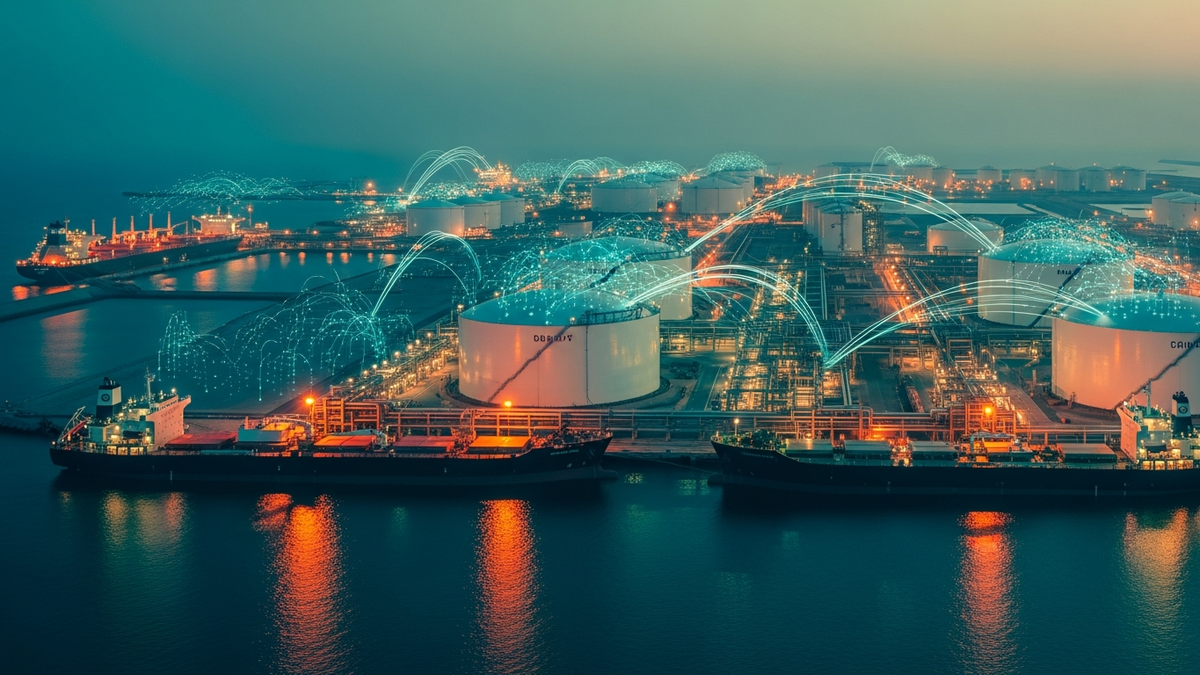
 ## Why AI is now part of every LNG conversation
AI data centres need baseload power, not variable power. A GW-scale campus running transformer training does not tolerate rolling curtailment, and battery storage does not yet cover the gap in most markets. Gas, especially LNG imported through long-term contracts, offers predictable pricing and steady supply. That is why US, UK, and Japanese utilities are negotiating multi-decade Qatari offtake contracts, and why AI hyperscalers are quietly standing behind them. The argument reshapes the climate conversation, because Gulf LNG is now being positioned as the transition fuel for the AI decade, not just for displaced coal.
> "I have absolutely no worries about future gas demand."
> — Saad Sherida al-Kaabi, Chief Executive, QatarEnergy, at Doha Forum 2025
> "The expectation of demand going forward has increased, now with AI and data centre requirements, which are sustained, baseload power requirements."
> — Saad Sherida al-Kaabi, QatarEnergy, at LNG2026
## Where the strategy could crack
Three risks sit inside the Qatar thesis. First, AI compute efficiency is improving faster than most forecasts assumed. Every generation of chips squeezes more tokens per watt, and inference workloads are moving toward smaller models. If demand peaks earlier than 2035, Qatar's 160 MTPA could arrive into a soft market. Second, carbon policy is tightening. The EU's Carbon Border Adjustment Mechanism, stricter methane reporting, and potential scope 3 emissions rules could all raise the effective cost of imported LNG. Third, the US shale competitor bench has deepened, and American export licences for LNG have become a geopolitical lever in ways that complicate Qatar's long game.
## Why AI is now part of every LNG conversation
AI data centres need baseload power, not variable power. A GW-scale campus running transformer training does not tolerate rolling curtailment, and battery storage does not yet cover the gap in most markets. Gas, especially LNG imported through long-term contracts, offers predictable pricing and steady supply. That is why US, UK, and Japanese utilities are negotiating multi-decade Qatari offtake contracts, and why AI hyperscalers are quietly standing behind them. The argument reshapes the climate conversation, because Gulf LNG is now being positioned as the transition fuel for the AI decade, not just for displaced coal.
> "I have absolutely no worries about future gas demand."
> — Saad Sherida al-Kaabi, Chief Executive, QatarEnergy, at Doha Forum 2025
> "The expectation of demand going forward has increased, now with AI and data centre requirements, which are sustained, baseload power requirements."
> — Saad Sherida al-Kaabi, QatarEnergy, at LNG2026
## Where the strategy could crack
Three risks sit inside the Qatar thesis. First, AI compute efficiency is improving faster than most forecasts assumed. Every generation of chips squeezes more tokens per watt, and inference workloads are moving toward smaller models. If demand peaks earlier than 2035, Qatar's 160 MTPA could arrive into a soft market. Second, carbon policy is tightening. The EU's Carbon Border Adjustment Mechanism, stricter methane reporting, and potential scope 3 emissions rules could all raise the effective cost of imported LNG. Third, the US shale competitor bench has deepened, and American export licences for LNG have become a geopolitical lever in ways that complicate Qatar's long game.
| Axis | Qatar strategy | Risk |
|---|---|---|
| Volume | Ramp to 160 MTPA by late 2020s | AI efficiency gains softening demand |
| Carbon | 9 MTPA CCS, blue ammonia | CBAM, methane leakage reporting |
| Offtake | Long-term contracts with US, UK, Japan, Korea | US LNG capacity expansion |
| Infrastructure | North Field West, Mesaieed ammonia | Capital discipline, project slippage |
| Geopolitics | Pivot of Europe from Russia | Peace outcomes, alternative pipelines |
The AI in Arabia View: QatarEnergy's pitch is the clearest sign yet that the AI industry will not be decarbonised on schedule. Baseload power is the hard problem that nobody loves talking about, and Qatar has just volunteered to be the adult in the room. The commercial logic is strong, the carbon footprint is not. Expect tighter scope 3 scrutiny, more methane reporting, and louder NGO pressure. But also expect Qatar's 160 MTPA to find homes, because AI compute is growing faster than any grid can absorb. If Doha pairs its volume ramp with real CCS delivery and independent methane verification, it will earn the seat it is asking for. If not, the reputational risk will travel with every cargo.
## Frequently Asked Questions
### Why is QatarEnergy talking so much about AI now?
AI data centres represent the fastest-growing segment of baseload power demand globally, and QatarEnergy wants its LNG to be framed as the primary fuel for that growth. The linkage helps justify long-term contracts, carbon capture investment, and infrastructure expansion in a market that is otherwise being told to decarbonise rapidly.
### How much new LNG capacity is coming online?
QatarEnergy expects to move from 77 MTPA today to 126 MTPA by 2027, with 160 MTPA once related projects are online. Key additions include the North Field expansion and the North Field West LNG project, with Mesaieed ammonia complementing the overall gas value chain.
### Can carbon capture keep Qatari LNG credible for AI buyers?
To some extent. QatarEnergy's 9 MTPA CCS target by 2030 is meaningful at wellhead and processing level, and blue ammonia projects add an additional decarbonised export pathway. But scope 3 emissions remain large, and NGO scrutiny will only grow, so credibility will depend on independent verification rather than in-house claims.
### What does this mean for AI companies?
AI companies should expect more Gulf-to-data-centre power narratives, more joint ventures between hyperscalers and Gulf energy firms, and more regulatory attention to AI's energy footprint. Boards should plan for higher energy-related disclosure obligations and start benchmarking training and inference carbon intensity against competitors.
Should AI hyperscalers lean harder into Qatari LNG, or accelerate the move to firmed renewables and advanced nuclear? Drop your take in the comments below.