## UAE Bets on AI Drug Discovery: InSilico Medicine and the Future of Gulf Pharma
The UAE has taken a significant step into the emerging field of AI-powered drug discovery. In February 2026, the **Emirates Drug Establishment** signed a partnership with **InSilico Medicine AI Limited**, a Hong Kong and US-based AI drug development company, at the **World Health Expo** in Dubai. The collaboration deploys generative AI and deep learning to accelerate drug discovery, evaluate compound candidates, predict toxicity, and reduce dependence on animal testing.
The agreement, signed by Dr. Fatima Al Kaabi of EDE and Dr. Alex Aliper of InSilico Medicine, positions the UAE as the first Gulf country to formalise an AI drug discovery partnership at the national regulatory authority level. It is a relatively small but strategically significant signal: the UAE is not simply adopting AI for healthcare administration and diagnostics, it is beginning to invest in the AI-enabled pharmaceutical research pipeline.
## What InSilico Medicine Does
**InSilico Medicine** is one of the most advanced AI drug discovery companies in the world. Its platform uses generative AI to design novel molecular structures, assess their potential therapeutic properties, predict how they will interact with biological targets, and screen them for toxicity before any laboratory synthesis. The company made history in 2023 when it advanced a drug candidate designed entirely by its AI system to Phase II clinical trials, the first time an AI-designed molecule had progressed that far.
The technology addresses one of the most expensive and time-consuming problems in medicine: the discovery phase of pharmaceutical development. Traditional drug discovery requires years of laboratory screening, animal trials, and iterative chemistry to identify candidates worth advancing to clinical trials. InSilico's AI platform compresses this timeline dramatically, enabling the evaluation of millions of molecular candidates in silico before any physical synthesis occurs.
For the UAE, which has a small but growing pharmaceutical manufacturing sector and significant ambitions to develop a high-value biotech industry, the partnership offers access to a technology capability that would otherwise require years to develop domestically.
### By The Numbers
- **2023**: Year InSilico Medicine advanced the first AI-designed drug molecule to Phase II clinical trials globally
- **$0.6 billion to $15 billion**: Projected growth of the MENA AI healthcare market from 2026 to 2035
- **100+**: Number of healthcare AI exhibitors at the AI Revolution in Healthcare Summit Dubai, March 2026
- **February 2026**: Date of the EDE-InSilico Medicine partnership signing at World Health Expo Dubai
- **150**: Government transaction types on Saudi Arabia's Absher platform, illustrating the digital health infrastructure AI sits on top of
## Emirates Health Services: Deploying AI Across UAE Facilities
While the InSilico partnership represents the cutting edge of healthcare AI investment, **Emirates Health Services** is doing the patient-facing work of deploying AI across the UAE's existing hospital and clinic network. **H.E. Mubaraka Ibrahim**, EHS's executive director, has described a dual mandate: AI tools for clinicians that improve diagnostic accuracy and reduce administrative burden, and AI tools for patients that improve access, personalisation, and health monitoring.
The clinical AI tools include decision support systems that flag potential diagnoses or drug interactions for physician review, automated analysis of medical imaging for oncology and radiology, and predictive risk models that identify patients at elevated risk of deterioration. These applications follow a pattern established in Singapore, the UK, and parts of the US, but the UAE deployment has the advantage of relatively centralised healthcare data, which creates better conditions for training accurate AI models than fragmented multi-payer systems.
The patient-facing tools include the AI-powered wearable monitoring programme, which provides continuous health data to patients and their clinical teams, and the expansion of telemedicine AI into remote and rural UAE communities, though the UAE's predominantly urban population means the latter has less acute urgency than in larger, more geographically dispersed Gulf countries.
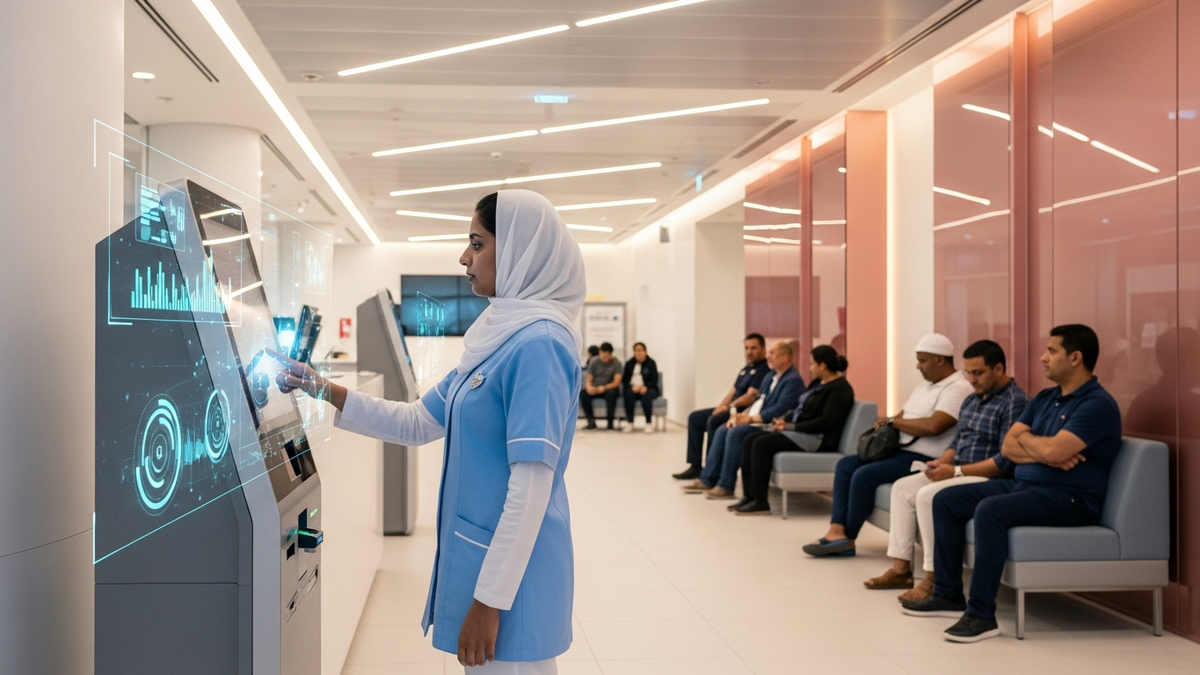
> "Emirates Health Services is deploying AI as a quality and access tool simultaneously. The technology must improve the experience for both the clinician and the patient, or we have not deployed it correctly."
> — H.E. Mubaraka Ibrahim, Emirates Health Services executive director
## The Arabic Medical NLP Challenge
A persistent gap in Gulf healthcare AI is the availability of Arabic-language medical AI tools that can process patient records, clinical notes, and discharge summaries accurately. The UAE's hospital system, like most Gulf healthcare environments, operates in a mixed Arabic-English documentation environment, with clinical notes often written in English by international medical staff while patient-facing communications occur in Arabic.
This creates AI training data challenges that are specific to the Gulf context. A diagnostic AI model trained primarily on English-language clinical text performs differently when applied to Arabic records, even if the underlying medical knowledge is language-agnostic. The [Arabic medical NLP research](/healthcare/rise-of-arabic-medical-nlp-training-ai-understand-patient-records) being developed at Gulf academic institutions, including the **AbjadMed Shared Task** launched at AbjadNLP 2026 in Morocco, is directly relevant to closing this gap.
| Healthcare AI Application | Gulf Example | Status | Key Benefit |
|---|
| AI drug discovery | EDE x InSilico Medicine | Partnership signed Feb 2026 | Faster compound evaluation |
| Clinical decision support | Emirates Health Services | Deployed across UAE facilities | Reduced diagnostic errors |
| AI triage (telehealth) | Seha Virtual Hospital (KSA) | Operational | Reduced A&E overcrowding |
| Medical imaging AI | Multiple UAE/KSA hospitals | Expanding deployment | Faster radiology review |
| Wearable health monitoring | EHS patient programme | Active | Continuous vital sign tracking |
## The Regulatory Dimension
AI in healthcare is one of the most heavily regulated applications of the technology globally, and the Gulf is no exception. The UAE's **Health Data Law**, combined with the broader **Personal Data Protection Law**, creates a framework for how patient data can be used for AI training and deployment. Health data is classified as a special category that requires explicit consent for processing, which creates real constraints on the data volumes available for training AI models.
For international companies like InSilico Medicine bringing AI platforms to the Gulf, navigating these regulatory requirements is a precondition for deployment. The EDE partnership likely involved significant legal and compliance structuring to ensure that the AI systems can be operated within UAE data governance frameworks while still accessing the clinical data needed to be useful.
The [CBUAE AI guidance for financial institutions](/policy/cbuae-ai-guidance-financial-institutions-2026) provides a useful reference for how a Gulf regulator approaches this challenge in another sector: principles-based governance that emphasises accountability and audit rights rather than technical mandates. The UAE Ministry of Health is likely to develop comparable guidance for healthcare AI as deployments proliferate.
The AI in Arabia View: The UAE's bet on AI drug discovery is the kind of long-term, high-risk, high-reward investment that distinguishes a serious innovation ecosystem from one that is just buying technology. EDE's partnership with InSilico Medicine will not produce a Gulf-manufactured drug in the next five years. But it plants a seed: regulatory expertise in evaluating AI-designed compounds, institutional knowledge of the drug discovery pipeline, and a relationship with one of the world's leading AI pharma companies. Combined with Emirates Health Services' operational AI deployment, the UAE is building a healthcare AI stack that goes from the discovery lab to the patient's wrist. That is genuinely ambitious and genuinely worth doing.
## Frequently Asked Questions
### What did the UAE's Emirates Drug Establishment sign with InSilico Medicine?
EDE and InSilico Medicine AI Limited signed a partnership in February 2026 at the World Health Expo in Dubai, deploying generative AI and deep learning for drug discovery, compound evaluation, toxicity prediction, and reducing reliance on animal testing in pharmaceutical research.
### What is InSilico Medicine known for?
InSilico Medicine is an AI drug discovery company that made history in 2023 by advancing the first AI-designed drug molecule to Phase II clinical trials. Its platform uses generative AI to design and screen molecular candidates before physical synthesis.
### What healthcare AI is Emirates Health Services deploying?
Emirates Health Services is deploying AI-powered clinical decision support, medical imaging analysis for oncology and radiology, predictive risk models for patient deterioration, AI-managed wearable health monitoring, and expanded telemedicine services across UAE facilities.
### How large is the MENA healthcare AI market?
The MENA AI healthcare market is projected to grow from $600 million in 2026 to $15 billion by 2035, driven by wearables, telemedicine, clinical decision support, and AI drug discovery partnerships such as the EDE-InSilico collaboration.
### What data governance rules apply to healthcare AI in the UAE?
The UAE's Health Data Law classifies patient data as a special category requiring explicit consent for processing. Combined with the UAE Personal Data Protection Law, these rules create specific requirements for how healthcare AI systems can access and use clinical data for training and deployment.
The UAE's dual investment in frontier AI drug discovery and wide-deployment clinical AI represents a healthcare strategy that is more coherent than most Gulf health systems have managed. The question now is whether the regulatory and data infrastructure can keep pace with the ambition. Drop your take in the comments below.
