From Cairo to the Cloud: Egypt's Play to Become Africa and the Arab World's AI Capital
Egypt ranks first in Africa for AI readiness, launches sovereign LLM Karnak, and captures 31% of African startup funding.
· Updated Apr 18, 2026 7 min read
When **Egypt** hosted the inaugural Ai Everything MEA summit in Cairo in February 2026, it was not simply staging a conference. It was making a statement. With 350 exhibitors from more than 30 countries and delegates from over 60 nations pouring into the Egyptian capital, Cairo declared itself the nexus between Gulf money and African ambition, between Arabic-language AI research and a continent of 1.4 billion people hungry for digital transformation.
The timing was no accident. Egypt had just been crowned the top-ranked nation in Africa for Government AI Readiness by Oxford Insights, climbing 14 places to 51st globally. It achieved a perfect 100 in the Policy Capacity pillar, tying with the United Kingdom and Australia. And at the summit itself, the government unveiled Karnak, a sovereign large language model purpose-built for Arabic, alongside a suite of AI-powered public services. For a country that has spent centuries as the cultural capital of the Arab world, the message was unmistakable: Egypt intends to become its technological capital, too.
## By The Numbers
| Indicator | Figure |
|---|---|
| Oxford Insights Government AI Readiness rank (Africa) | 1st |
| Global AI Readiness rank | 51st (up from 65th) |
| Policy Capacity pillar score | 100 / 100 |
| AI contribution to GDP target by 2030 | $42.7 billion (7.7% of GDP) |
| AI specialists target by 2030 | 30,000 |
| Startup funding raised in 2025 | $614 million |
| Share of Africa's H1 2025 startup funding | 31% |
| Ai Everything MEA 2026 exhibitors | 350+ from 30+ countries |
## A Sovereign Model for a Sovereign Ambition
The launch of Karnak at Ai Everything MEA was the centrepiece of Egypt's AI offensive. Developed under the auspices of the Information Technology Industry Development Agency (**ITIDA**) and the Ministry of Communications and Information Technology (**MCIT**), the model is designed as a foundation on which startups, enterprises, and government agencies can build Arabic-language AI solutions. Karnak ranks among the highest-performing Arabic LLMs in the 30–40 and 70–80 billion parameter ranges, positioning it as a direct competitor to the UAE's [Falcon H1 Arabic](/news/falcon-h1-arabic-abu-dhabi-open-source-model) and the growing influence of China's open-source models in the region.
> "Egypt's AI strategy is not about catching up. It is about leapfrogging, using our unique position at the crossroads of the Arab world and Africa to build AI that serves both." - **Dr Amr Talaat**, Egypt's Minister of Communications and Information Technology
Alongside Karnak, the government launched SIA, an AI-powered tutor for Arabic language and Egyptian history education in secondary schools, and an AI legal and regulatory assistant designed to help citizens and small businesses navigate Egypt's complex regulatory landscape. These are not vanity projects. They represent a deliberate strategy to embed AI into the daily fabric of Egyptian life, creating demand for the very AI talent the country is racing to produce.
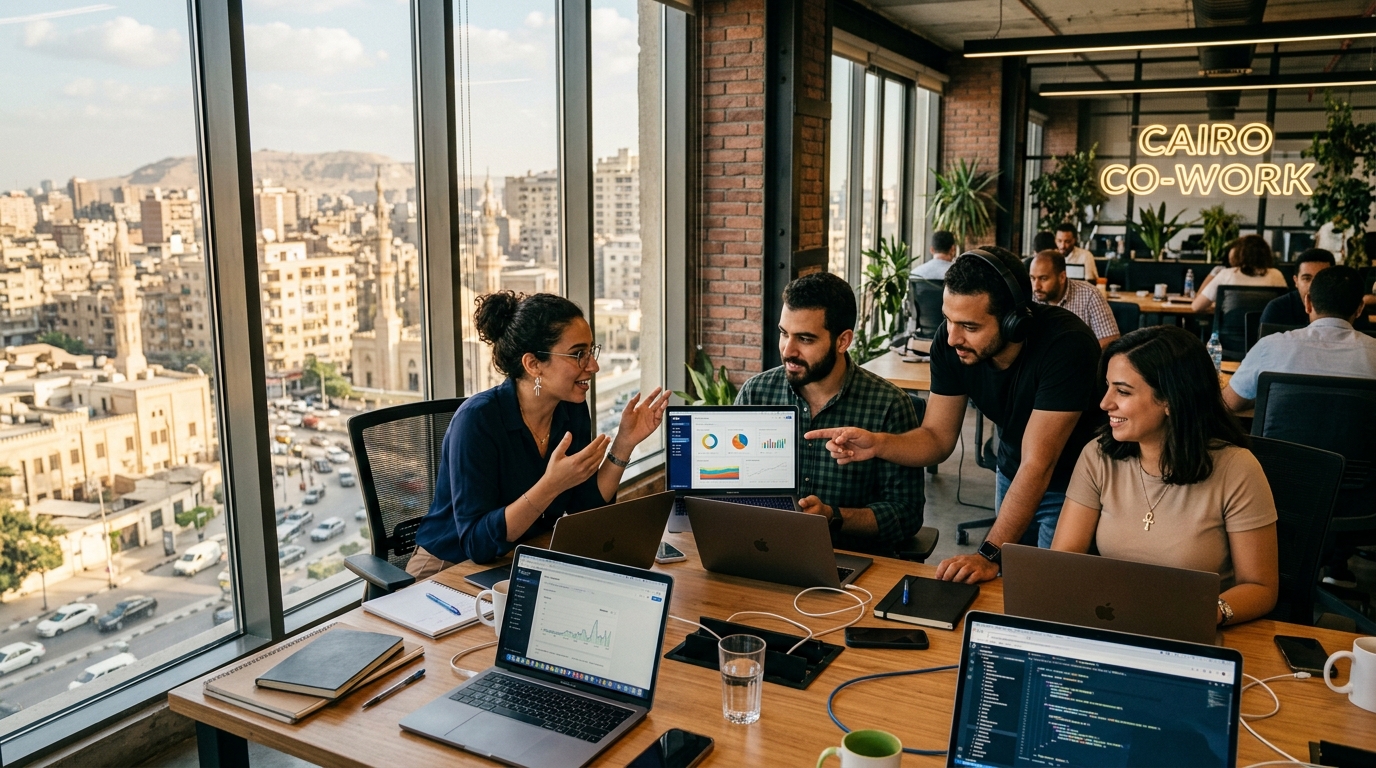
Cairo's growing network of tech co-working spaces has become the launchpad for Egypt's AI startup ecosystem.
## The Startup Capital of Africa
The numbers tell a compelling story. Egyptian startups raised $614 million in venture capital and debt financing in 2025, and in the first half of that year alone, Egyptian founders captured a staggering 31% of all African startup funding, roughly $339 million. In Q1 2026, Egypt's $190 million haul exceeded Nigeria's $78 million and nearly matched South Africa's $157 million, cementing its position as [the continent's most active funding destination](/business/new-gulf-gold-rush-mena-ai-startups-funded-2025).
What distinguishes Egypt's startup scene is the nature of the capital flowing in. Gulf investors, particularly from Saudi Arabia and the UAE, are increasingly treating Cairo as a proximate bet on Arabic-language technology. **WideBot**, which raised a $3 million pre-Series A from a consortium including Enza Capital, **DisrupTech Ventures**, and SparkLabs, is building a large language model specifically for Arabic conversational AI. **Intella**, which secured a $12.5 million Series A backed by **Prosus** and Gulf-based funds **Wa'ed Ventures** and **Hala Ventures**, is tackling enterprise AI tools for Arabic-language business operations. **Aria Ventures**, a Cairo-based venture studio, launched a $1 million deep-tech fund targeting AI, machine learning, biotechnology, and robotics startups, with plans to scale to $4 million over four years.
> "The concentration of Gulf capital in Egypt's AI rounds is not coincidental. Saudi and UAE funds see Egypt as the most efficient way to invest in Arabic AI talent at scale." - **Nader Sabry**, Gulf-based technology strategist
The dynamic is straightforward: Gulf sovereign wealth and corporate capital seeks Arabic-language AI capabilities; Egypt supplies the talent and the startups. It is a symbiosis that benefits both sides, and one that is [reshaping MENA's broader startup ecosystem](/startups/mena-ai-startup-funding-record-highs-gulf-investors-doubling-down).
## The $42.7 Billion Roadmap
Egypt's second National AI Strategy, covering 2025–2030, is arguably the most ambitious AI policy document to emerge from any African nation. The headline target is eye-catching: AI is expected to contribute $42.7 billion to GDP by 2030, equivalent to 7.7% of the total. The strategy rests on six pillars, spanning governance, technology, data, infrastructure, ecosystem, and talent.
On the talent front, Egypt aims to produce 30,000 AI specialists by 2030 and grow its AI startup count from roughly 150 to 250. The government has also set a target of doubling AI research publications to 6,000 per year, positioning Egyptian universities as regional research hubs. This ambition builds on Egypt's existing strengths: the country already produces more engineering and computer science graduates than any other nation in the Middle East and Africa, and its labour costs remain a fraction of those in the Gulf.
The infrastructure piece is equally critical. Egypt's data centre capacity is expanding rapidly, driven by both domestic investment and foreign interest. The US International Trade Administration has identified Egypt's ICT sector as one of the country's most promising growth areas, noting the government's push to position Egypt as a regional data centre hub.
## Bridge Between Two Worlds
Egypt's geographic and cultural position gives it a strategic advantage that no amount of sovereign wealth can replicate. Sitting at the junction of the Arab world and sub-Saharan Africa, Egypt is uniquely placed to channel Gulf capital southward and African talent northward. The [HUMAIN partnership ecosystem](/business/humain-saudi-arabia-nvidia-amd-600000-gpu-deployment) being built in Saudi Arabia, for instance, will need Arabic-speaking AI engineers and researchers, many of whom Egypt can supply. Conversely, African startups seeking access to Gulf markets increasingly look to Cairo as a gateway.
This bridging role was on full display at Ai Everything MEA. The summit's IMPACT initiative, launched by ITIDA, is explicitly designed to connect Egyptian AI capabilities with demand across the Middle East and Africa. **Microsoft**, **Cisco**, **HPE**, **Amazon Web Services**, and **Capgemini** all exhibited, alongside regional players like **Alkan** and **Link Data Center**, and AI-native startups including WideBot AI, **EZELINK**, and **Zakaa**.
> "Egypt is not just competing for AI investment. It is positioning itself as the connective tissue between Gulf capital and African innovation." - **Ahmed El-Zaher**, CEO of ITIDA
The parallels with Egypt's historical role are hard to miss. Just as Cairo has long served as the publishing capital of the Arabic language and the cultural bridge between North Africa and the Levant, it is now fashioning itself as the AI intermediary, the city where [Gulf compute infrastructure](/news/mena-sovereign-ai-compute-site-level-audit) meets African demographic dynamism.
### THE AI IN ARABIA VIEW
Egypt's AI play is the most strategically interesting in the MENA region precisely because it is not driven by oil wealth. Where Saudi Arabia and the UAE can spend their way to AI infrastructure, Egypt must build on talent, policy, and positioning. The Karnak sovereign LLM, the perfect Oxford Insights policy score, and the $42.7 billion GDP target are all pieces of a coherent strategy to make Egypt indispensable to the region's AI future. The risk, as always, is execution: bureaucratic inertia, brain drain to the Gulf, and infrastructure bottlenecks could slow progress. But the fundamentals, including a young, tech-savvy population of over 100 million, the largest Arabic-speaking talent pool on earth, and a government that has staked its modernisation agenda on AI, make Egypt the MENA AI story most worth watching in 2026.
## FAQ
### How does Egypt rank in AI readiness compared to other African nations?
Egypt ranks first in Africa in the 2025 Oxford Insights Government AI Readiness Index and 51st globally, having climbed 14 places from the previous year. It scored a perfect 100 in the Policy Capacity pillar, the highest of any nation in that category.
### What is Karnak and why does it matter?
Karnak is Egypt's sovereign large language model, launched at the Ai Everything MEA summit in February 2026. It is designed as a foundation for Arabic-language AI applications across government, enterprise, and education, and ranks among the top Arabic LLMs in the 30–80 billion parameter range.
### How much startup funding did Egypt attract in 2025?
Egyptian startups raised approximately $614 million in venture capital and debt financing in 2025. In the first half of the year, Egypt captured 31% of all African startup funding, making it the continent's leading destination for tech investment.
### What is Egypt's AI contribution target for 2030?
Egypt's second National AI Strategy targets a $42.7 billion contribution from AI to GDP by 2030, equivalent to 7.7% of the economy, alongside 30,000 trained AI specialists and 250 AI startups.
### Why are Gulf investors so active in Egypt's AI ecosystem?
Gulf sovereign wealth funds and corporate investors view Egypt as the most cost-effective way to invest in Arabic-language AI talent at scale. Egypt's large pool of engineering graduates, lower labour costs, and cultural proximity to Gulf markets make it an attractive destination for AI-focused capital.
## Closing Thoughts
Egypt's AI ambitions are not built on chequebooks but on a century of cultural and intellectual leadership in the Arab world, now redirected toward artificial intelligence. Whether Cairo can translate policy ambition and startup energy into lasting technological influence depends on execution in the coming years. But as the only country in the MENA region that can genuinely claim to be a bridge between the Arab world and Africa, Egypt's AI story is one that extends far beyond its own borders.
Drop your take in the comments below.
