## AI and the Gulf's Urban Future: What Dubai's Smart City Summit Tells Us About NEOM and Masdar
The **AI for Smart City and Urban Systems** conference, running in Dubai from 13 to 17 April 2026, represents a moment of stocktaking for the Gulf's most ambitious urban AI projects. With NEOM's construction timeline under active scrutiny and Masdar City's quiet but steady progress, the conference is an opportunity to assess where the region's smart city ambitions sit between vision and operating reality.
The Gulf has invested more heavily in smart city architecture than almost any other region globally, driven by a combination of petrodollar funding, relatively new urban infrastructure that was designed after the era of digital building management systems, and a political will to use cities as demonstrations of national AI capability. The outcomes have been uneven, but the trajectory is becoming clearer.
## NEOM: The Cognitive Infrastructure Question
**NEOM**, Saudi Arabia's $500 billion linear city project in the Tabuk region, remains the world's most watched smart city project, not primarily for its architecture, but for what it is attempting to do with AI at the operational layer. **The Line**, the project's flagship 170-kilometre linear residential structure, has been described by NEOM's leadership as a "cognitive city": one in which AI systems manage everything from traffic flow and energy distribution to resident services and predictive maintenance.
The [cognitive infrastructure article we published last week](/smart-cities/neom-the-line-cognitive-infrastructure-ai-backbone) explored the technical architecture in detail. The key point for this summit discussion is that NEOM's AI ambitions require not just hardware infrastructure, the servers and sensors that underpin a smart building system, but a genuinely integrated AI operating layer that can make real-time decisions across the city's systems simultaneously.
No city in the world has fully deployed such a system at NEOM's proposed scale. The closest analogues are Singapore's city-state management platform and some district-level implementations in Songdo, South Korea, and Sidewalk Labs' Quayside project in Toronto, which was ultimately cancelled. NEOM's ambition exceeds all of these, which means it is attempting to build something that does not have a proven template.
### By The Numbers
- **$500 billion**: Announced investment in NEOM across all development phases
- **170 km**: Planned length of The Line, NEOM's flagship linear city structure
- **200 MW**: Capacity of the Stargate UAE data centre cluster on track for Q3 2026, providing regional compute for smart city applications
- **$320 billion**: AI's projected economic contribution to MENA by 2030, with smart infrastructure among the primary value sectors
- **1.5 GW**: Total planned capacity of Abu Dhabi's AI supercomputing cluster, supporting smart city and government AI workloads
## Masdar City: The Long Game
While NEOM captures global attention, **Masdar City** in Abu Dhabi represents a quieter but more operationally grounded model of smart urban AI. The city has been under construction since 2008 and has operated as a real-world testbed for sustainable urban systems, AI-managed energy grids, and autonomous personal rapid transit since well before the current wave of AI enthusiasm.
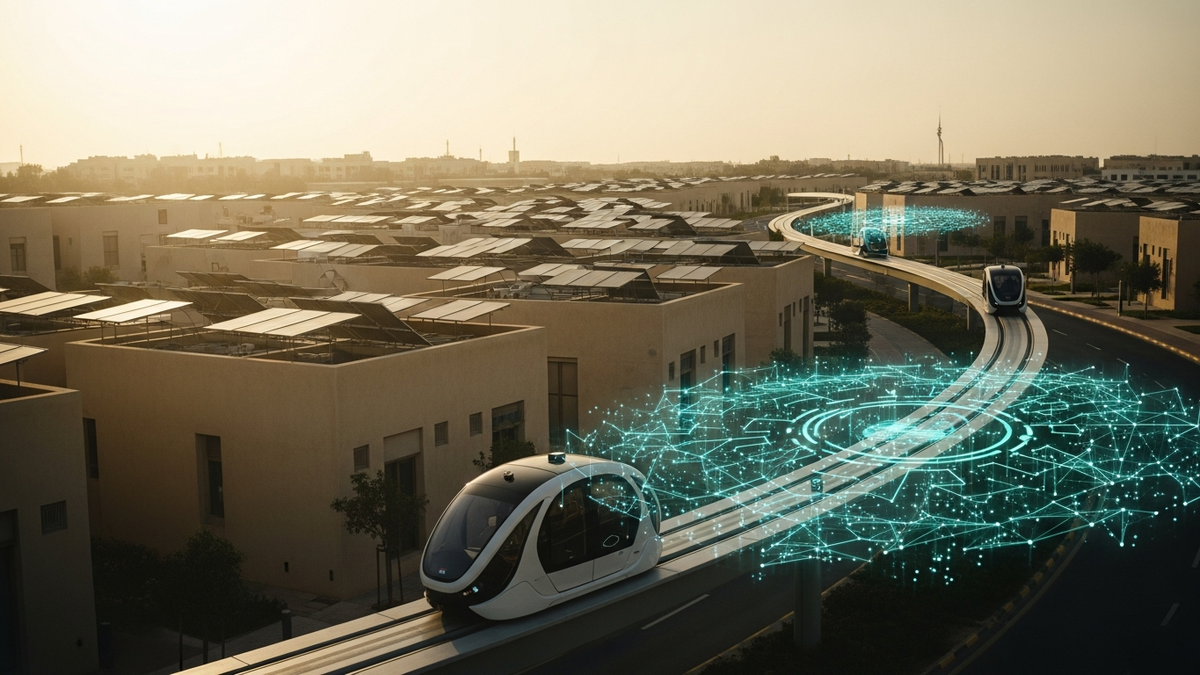
The lessons from Masdar are instructive for NEOM and for urban AI projects across the region. The city's **Personal Rapid Transit** system, a network of driverless electric pods running on raised tracks, was originally planned to cover the entire city. In practice, it operates only in the initial district due to cost and complexity, demonstrating the gap between smart city vision and operational scalability.
Masdar's energy management systems, however, have performed significantly better. The city's AI-managed solar and energy storage grid, operated by **Masdar** (the clean energy company, distinct from the city), achieves energy efficiency metrics that substantially outperform conventional commercial buildings, providing a concrete demonstration of AI value in urban systems management.
> "Masdar City has been teaching us something for fifteen years: the hardest problem in smart cities is not the AI, it is the integration between the AI and the physical infrastructure it is supposed to manage. The sensors break. The data streams are inconsistent. The edge cases are infinite."
> — Urban AI researcher, AI for Smart City Conference Dubai, April 2026
## The Dubai Smart City Model
Dubai offers a third model, distinct from both NEOM's greenfield ambition and Masdar's isolated testbed approach. **Smart Dubai**, the emirate's government AI initiative, has focused on retrofitting AI capabilities into existing urban infrastructure rather than building from scratch, embedding AI into traffic management, public services, waste management, and predictive maintenance across a city that is already operational and inhabited by millions.
This approach is less glamorous but more immediately useful. Dubai's **AI Traffic Management System** uses real-time data from cameras, sensors, and GPS devices to dynamically adjust signal timing across the city's road network, reducing average commute times in monitored corridors by a measurable percentage. The system is not speculative; it is running, handling data, and producing outcomes that can be measured.
The **Dubai 10X** initiative, which aims to put Dubai ten years ahead of the rest of the world across a range of sectors, has AI as a central enabling technology for smart city applications from autonomous government services to predictive utility management.
| Project | Model | Status | Key AI Application |
|---|
| NEOM/The Line | Greenfield design-first | Construction phase | Cognitive city operating system |
| Masdar City | Sustainable testbed | Operational (partial) | Energy management, autonomous transit |
| Smart Dubai | Retrofit + integration | Operational at scale | Traffic, public services, utilities |
| KAFD (Riyadh) | Business district AI | Operating and expanding | Building management, visitor services |
## What the Summit Is Trying to Answer
The AI for Smart City conference in Dubai is notable precisely because it sits between the announcement cycle that dominates Gulf smart city coverage and the operational data that would allow proper evaluation. Its panels and workshops are designed to answer practical questions: which AI applications have delivered measurable returns in Gulf urban environments, what infrastructure is actually required versus what is aspirational, and how do cities manage the data governance challenges of integrating AI across public and private infrastructure.
These questions matter because the Gulf's smart city ambitions are genuinely consequential. If NEOM's cognitive operating layer works, it will become a reference architecture for urban AI globally. If it doesn't, the cost will be measured not just in financial terms but in the credibility of ambitious AI infrastructure investment as a development strategy.
The [Stargate UAE construction progress](/news/stargate-uae-construction-milestone-april-2026) is directly relevant here: sovereign AI compute at the scale Abu Dhabi is building is a precondition for the kind of real-time AI city management that both NEOM and Smart Dubai aspire to.
The AI in Arabia View: The Gulf's smart city projects exist on a spectrum from operational and useful (Smart Dubai's traffic management) to visionary and unbuilt (NEOM's cognitive operating system). The honest answer to "how is MENA smart city AI doing?" is that the cities retrofitting AI into existing infrastructure are delivering results today, while the greenfield projects remain extraordinary bets on unproven integration at unprecedented scale. Both approaches are worth pursuing, but the Gulf needs to be more rigorous about measuring the operational cities against their stated outcomes rather than only celebrating the announcements from the construction sites.
## Frequently Asked Questions
### What is NEOM's cognitive infrastructure?
NEOM's cognitive infrastructure refers to the AI operating system planned for The Line, designed to manage energy, transport, utilities, resident services, and predictive maintenance across the 170-kilometre linear city in real time. No comparable system exists at this scale in any existing city.
### How does Masdar City use AI?
Masdar City uses AI primarily for energy management, optimising its solar power and energy storage systems to achieve significantly higher efficiency than conventional buildings. Its original autonomous personal rapid transit system operates only partially due to cost and complexity challenges.
### What is Smart Dubai's AI Traffic Management System?
Smart Dubai's AI Traffic Management System uses real-time data from sensors, cameras, and GPS to dynamically adjust traffic signal timing across Dubai's road network. It operates at city scale and has demonstrated measurable commute time improvements in monitored corridors.
### What AI applications are most proven in MENA smart cities?
Energy management AI, traffic management AI, and AI-powered public services platforms have the strongest track records in MENA urban environments. Fully autonomous city operating systems at NEOM's proposed scale remain undeployed anywhere globally.
### How does the Stargate UAE project relate to smart cities?
The Stargate UAE data centre cluster in Abu Dhabi provides the sovereign AI compute infrastructure that both NEOM's cognitive city ambitions and Smart Dubai's expanding AI applications depend on. Sovereign compute at this scale is a precondition for the AI city management systems the Gulf is building towards.
The Gulf's smart city AI story is unfinished, which is part of what makes it interesting. The region is running three simultaneous experiments, greenfield design, controlled testbed, and large-scale retrofit, and the results of all three will have implications for how cities everywhere approach AI integration over the next decade. Drop your take in the comments below.
