
 ## The rival blueprints in Abu Dhabi, Doha, and Muscat
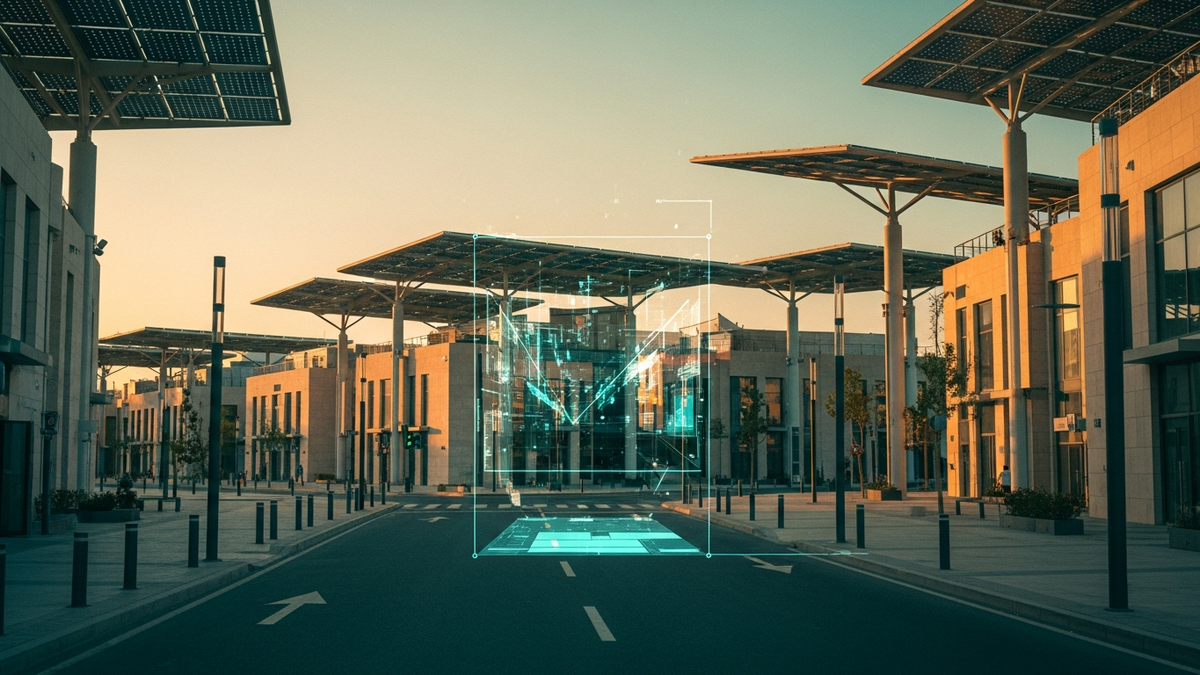
**Masdar City 2.0** has doubled down on AI-optimised energy. Predictive algorithms now pair with adaptive microgrids that self-heal during peak loads, and demos at this week's sessions targeted 99.8% renewable uptime. In Doha, **Lusail** showed AI traffic orchestration that claims to cut congestion 42% via real-time vehicle-to-infrastructure signalling, with holographic displays guiding connected shuttles along its waterfront. **Riyadh Downtown** is leaning on a neural network-managed grid that balances 2.5 gigawatts of solar input using millisecond-scale edge AI routing. **Muscat's Sultan Haitham City** leans into digital twins that simulate urban growth to cut water waste by up to 30%, blending Omani heritage with drone-monitored green corridors.
> "NEOM is positioning itself as the central nervous system of the global AI economy."
> — NEOM leadership briefing, MENA smart-cities conference, April 2026
> "The Line smart city is reportedly now being rethought as an AI data centre, which the country expects to bring a greater short-term return."
> — Reuters and local industry commentary, April 2026
## The physics the pivot must respect
Turning The Line into an AI server corridor does not remove the physics challenges that slowed the residential plan. Dust control, heat, water intake impacts on Red Sea ecology, grid balancing, and electricity pricing all need answers. The seawater cooling pitch is well grounded on paper, but sustained AI workloads at 5 to 10 gigawatts would have real marine ecosystem implications without careful thermal diffusion. Workforce construction is easier than before, because 35% fewer residential amenities are needed, but the precision engineering of large-scale thermal and compute infrastructure is just as demanding. The test for Saudi Arabia is whether it can execute something unprecedented while rival hubs lock in more predictable builds.
## The rival blueprints in Abu Dhabi, Doha, and Muscat
**Masdar City 2.0** has doubled down on AI-optimised energy. Predictive algorithms now pair with adaptive microgrids that self-heal during peak loads, and demos at this week's sessions targeted 99.8% renewable uptime. In Doha, **Lusail** showed AI traffic orchestration that claims to cut congestion 42% via real-time vehicle-to-infrastructure signalling, with holographic displays guiding connected shuttles along its waterfront. **Riyadh Downtown** is leaning on a neural network-managed grid that balances 2.5 gigawatts of solar input using millisecond-scale edge AI routing. **Muscat's Sultan Haitham City** leans into digital twins that simulate urban growth to cut water waste by up to 30%, blending Omani heritage with drone-monitored green corridors.
> "NEOM is positioning itself as the central nervous system of the global AI economy."
> — NEOM leadership briefing, MENA smart-cities conference, April 2026
> "The Line smart city is reportedly now being rethought as an AI data centre, which the country expects to bring a greater short-term return."
> — Reuters and local industry commentary, April 2026
## The physics the pivot must respect
Turning The Line into an AI server corridor does not remove the physics challenges that slowed the residential plan. Dust control, heat, water intake impacts on Red Sea ecology, grid balancing, and electricity pricing all need answers. The seawater cooling pitch is well grounded on paper, but sustained AI workloads at 5 to 10 gigawatts would have real marine ecosystem implications without careful thermal diffusion. Workforce construction is easier than before, because 35% fewer residential amenities are needed, but the precision engineering of large-scale thermal and compute infrastructure is just as demanding. The test for Saudi Arabia is whether it can execute something unprecedented while rival hubs lock in more predictable builds.
| Project | Country | AI angle | Big risk |
|---|---|---|---|
| The Line, NEOM | Saudi Arabia | 170 km AI server corridor, seawater cooling | Ecology, execution at scale |
| Masdar City 2.0 | UAE | AI microgrid, 99.8% renewable uptime | Cost of storage at scale |
| Lusail | Qatar | AI traffic and V2I orchestration | Vendor lock-in, data privacy |
| Riyadh Downtown | Saudi Arabia | Neural-network grid, edge AI rerouting | Cyber-resilience, transparency |
| Sultan Haitham City | Oman | Digital twin for water and heritage | Execution discipline, funding |
The AI in Arabia View: The Line's pivot is not a retreat, it is a recalibration that finally matches Saudi Arabia's ambition to a real global market. Residential megacities are a political product, AI infrastructure is an economic one. The region that will win MENA's smart-city decade is the one that gives the cleanest answer to three questions: whose compute runs here, how is it cooled, and who pays when the algorithms fail. Masdar 2.0, Lusail, and Muscat's Sultan Haitham City each have parts of that answer. NEOM has the most to prove, because 170 kilometres of seawater-cooled AI is either the boldest infrastructure story of the decade or the most expensive correction.
## Frequently Asked Questions
### Is The Line being cancelled?
No. The Line is being repositioned. The 170-kilometre footprint remains in play, but the near-term use case is AI compute infrastructure with seawater cooling, rather than residential housing for nine million people. Saudi leadership treats this as a pivot toward faster, more measurable economic returns.
### Which MENA smart city is furthest along on AI today?
**Masdar City 2.0** in Abu Dhabi is arguably the most operationally advanced, thanks to its AI-optimised microgrid and high renewable uptime. **Lusail** in Qatar leads on AI-driven traffic orchestration. **Riyadh Downtown** is ahead on neural-network grid management. Together they form a regional stack that is the first real competitor to Asian smart-city hubs.
### How does seawater cooling actually work at this scale?
Deep seawater is pumped through heat exchangers that draw heat from data-centre cooling loops, then returned at controlled temperatures. At Red Sea scale, the approach depends on careful thermal diffusion, ecological impact modelling, and redundant intake designs. It is well understood in principle, but rarely executed at the sustained gigawatt loads AI training demands.
### Who will tenant The Line's AI corridor?
Expected tenants include **HumAIn**, **ALLaM** workloads from SDAIA, **Aramco Digital**, and rotating international hyperscalers that need sovereign-grade capacity. The commercial model will likely mirror long-term power purchase agreements, with tenants buying both compute and power from the corridor at fixed rates.
Which MENA smart-city bet will age best by 2030, and which one is quietly at risk? Drop your take in the comments below.